
Everyone has heard the headline: the UN is "moving to Nairobi," three global headquarters are coming, and the Gigiri "Blue Zone" is about to explode. We verified every part of that sentence against primary sources. Some of it is true, some of it was never announced, and the property data is pointing somewhere the headline never mentions. This is what we found.
Data in this report draws on the ArdhiHome Kenya Property Market Index (549 neighbourhood-level data points across Nairobi Metro, the Mombasa Coast and satellite towns), the HassConsult Q2 2026 Land Price Index, UN News, UNFPA, UN budget advisory documents and established Kenyan press. Every figure is sourced, and where the record is unconfirmed, we say so.
The headline everyone heard
Somewhere in the last year, you have probably seen a version of this: the United Nations is relocating the global headquarters of UNICEF, UNFPA and UN Women from New York to Nairobi by the end of 2026, bringing thousands of staff and their housing allowances into Gigiri's "Blue Zone."
It is a magnificent story. It travelled through WhatsApp groups, diaspora forums and listing pages. Developers put "UN Blue Zone" in project names. Off-plan studios five minutes from the UN gate began marketing themselves on the strength of it.
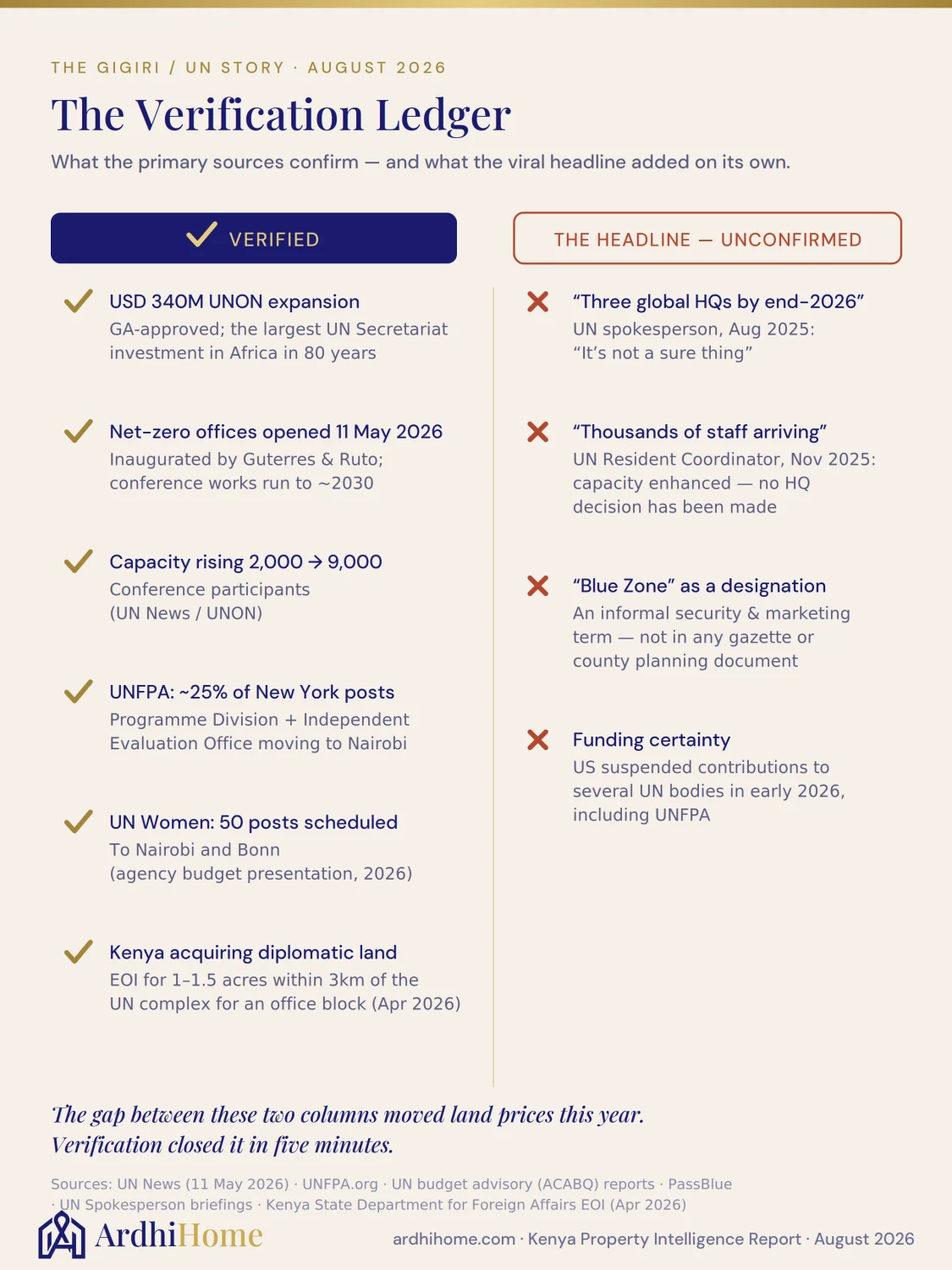
Here is the problem. The UN never actually announced it.
When reporters asked the UN's deputy spokesperson, Farhan Haq, to confirm the three-headquarters story in August 2025, his answer was five words long: "It's not a sure thing." He described it as one option among several, at an early stage, still being discussed with agency executive boards. Three months later, in November 2025, the UN's own Resident Coordinator in Kenya, Dr. Stephen Jackson, went further — clarifying publicly that the three agencies are enhancing their capacity in Nairobi but have not decided to move their headquarters. And in early 2026, the United States suspended contributions to multiple UN institutions, including UNFPA — pulling a load-bearing beam out of the financial projections that underpinned the whole relocation conversation.
The viral version of the Gigiri story, in other words, is a rumour that outran its source. And the market traded on it anyway.
What is actually confirmed — and it's still big
Strip away the unconfirmed headline and what remains is not a small story. It is a verified one — which is better.
On 11 May 2026, Secretary-General António Guterres stood next to President William Ruto in Gigiri and inaugurated the UN Office at Nairobi's first net-zero office buildings, then broke ground on a new conference facility. The overall project, approved by the UN General Assembly, is worth USD 340 million — the largest investment the UN Secretariat has made in Africa in its 80-year history. It will raise UNON's conference capacity from 2,000 to 9,000 participants, with the conference works running to around 2030. Guterres called Nairobi "neither a satellite nor an outpost" but "a pillar — the only United Nations headquarters in Africa and in the Global South." That is the UN's own language, published by UN News, about a campus that already hosts more than 70 UN offices and programmes.
The staff movements that are confirmed are function-level, not headline-level. UNFPA states on its own website that roughly 25 per cent of its New York-based posts are moving to Nairobi — its Programme Division and Independent Evaluation Office — a relocation the UN's budget advisory committee reported as scheduled for completion by the end of 2025, with projected savings of USD 7.5 million over 2026–2029. UN Women's budget presentation, reported by PassBlue in early 2026, identifies 50 posts scheduled to move from New York to Nairobi and Bonn. Hundreds of posts, phased over years. Not thousands by Christmas.
And the Kenyan state is committing on its side of the ledger: in April 2026, the State Department for Foreign Affairs issued a public expression of interest to acquire 1 to 1.5 acres within a three-kilometre radius of the UN complex for a multi-storey diplomatic office block to house missions to UNEP and UN-Habitat.

One more piece of verification, because our readers deserve precision: the "Blue Zone" is not an official designation. You will not find it in a gazette notice or a Nairobi County planning document. It is an informal term — borrowed from UN blue — for the belt of neighbourhoods considered secure and suitable for UN staff residence: Gigiri, Runda, Muthaiga, Nyari, Rosslyn, Kitisuru. Its practical anchor is that UN staff are advised to consult the UN's own Security and Safety Service before choosing housing. That security guidance is real, and it genuinely concentrates expatriate tenants in the belt. But when a listing sells you a "Blue Zone designation," understand what you are buying: a convention, not a title condition.
So the confirmed story is this: a USD 340 million campus, hundreds of relocated posts, a government acquiring diplomatic land, and a Secretary-General publicly anchoring the UN's African future in Gigiri. Real, funded, and slow. Now watch what the property market did with it.
The epicentre is falling while the ring rises
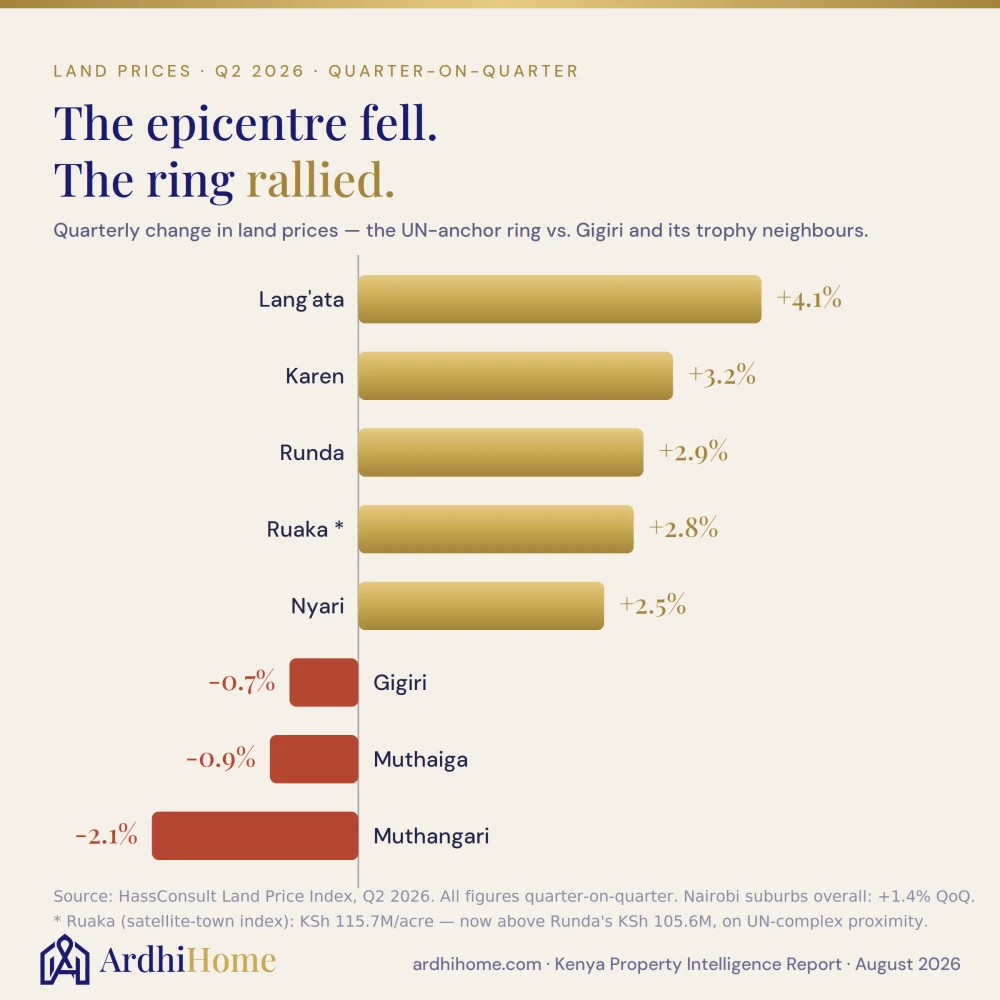
If the headline were the truth, Gigiri land should be the hottest asset in Nairobi. Here is what the HassConsult Land Price Index actually recorded for the second quarter of 2026, all figures quarter-on-quarter: Nairobi suburb land prices rose 1.4 per cent overall — and Gigiri fell 0.7 per cent. Muthaiga fell 0.9 per cent. Muthangari fell 2.1 per cent.
Meanwhile, the ring around the epicentre rallied. Runda rose 2.9 per cent to KSh 105.6 million an acre. Nyari gained 2.5 per cent to KSh 128.2 million. Karen jumped 3.2 per cent to KSh 79.5 million — with Lang'ata, at 4.1 per cent, posting the strongest suburb growth of the quarter. And out on the satellite ring, Ruaka rose 2.8 per cent to KSh 115.7 million an acre — meaning an acre in Ruaka, the dense apartment corridor ten minutes from the UN gate, now costs more than an acre in Runda. HassConsult explicitly links Ruaka's demand to its location near the UN complex and the wider diplomatic zone.
The epicentre down, the ring up. Why?
Three reasons, all verifiable. First, Gigiri is tiny. It carries the smallest land market share of all 18 Nairobi suburbs HassConsult tracks — about 1 per cent. There is almost nothing to transact, so a handful of speculative deals can swing the price in either direction, and there is no depth to absorb hype.
Second, the hype already happened. Gigiri land was flat in early 2025, spiked after the relocation headlines went viral mid-year, and has been giving that premium back since the UN walked the story back. This is not even the first time: as far back as 2023, HassConsult's Sakina Hassanali noted that Gigiri, Kitisuru and Nyari "corrected after several quarters of heated pricing on expansion of Kenya's diplomatic zone." The diplomatic premium gets pre-priced by speculators on every news cycle, then mean-reverts. The rumour trades; the reality rents.
Third — and this is where our own index earns its keep — Gigiri is structurally a landlord's market, not a buyer's market. Across the 549 neighbourhood combinations ArdhiHome tracks, Gigiri currently shows just 9 properties listed for sale, at a median asking price of KSh 150 million, against 84 properties for rent at a median of KSh 640,000 per month — the highest median rent in the entire corridor, 60 per cent above Runda's KSh 400,000. Read that ratio again: nine to buy, eighty-four to rent. The UN expansion's economics flow overwhelmingly to people who already own in Gigiri. A new buyer chasing the headline finds a near-empty shelf at a nine-figure entry price and a gross yield of about 5 per cent.

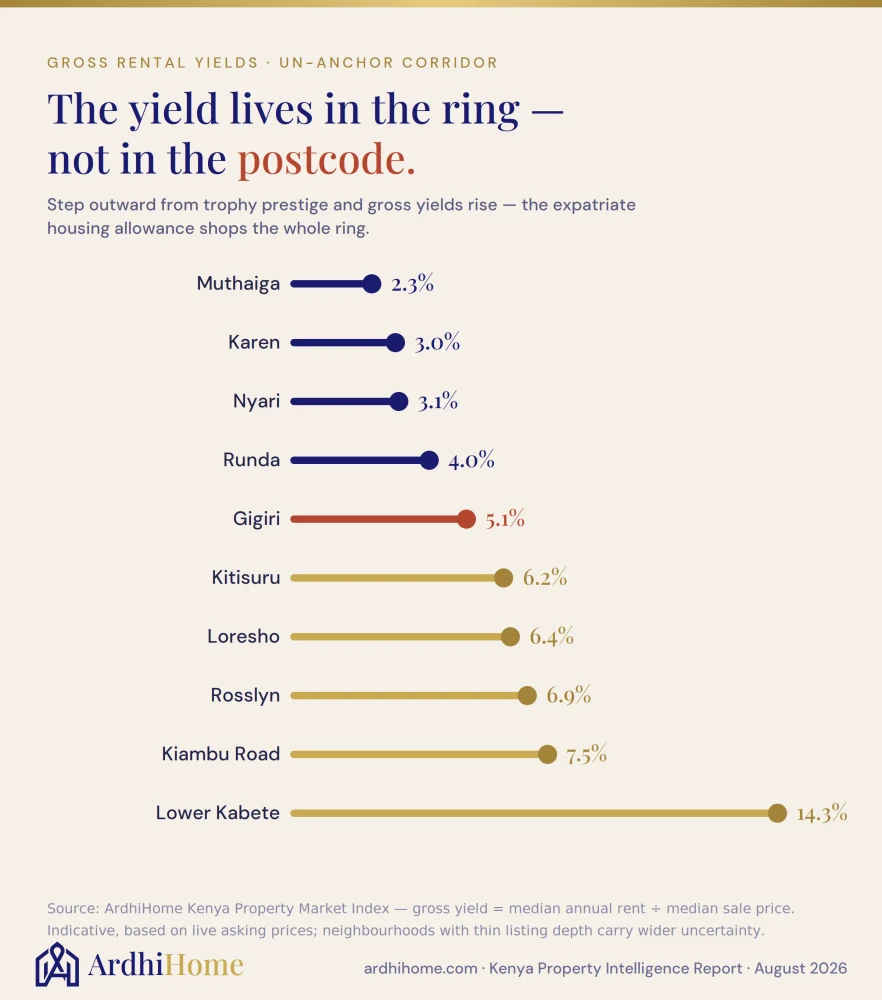
Now look at where the yield actually lives. Our index shows the corridor's returns rising as you step outward from trophy prestige: Muthaiga at roughly 2.3 per cent gross, Karen 3.0, Nyari 3.1, Runda 4.0, Gigiri 5.1 — then Kitisuru 6.2, Loresho 6.4, Rosslyn 6.9, the Kiambu Road corridor 7.5, and Lower Kabete at roughly 14 per cent, where a KSh 43.5 million median entry meets a KSh 520,000 median rent from tenants who want to be fifteen minutes from the UN gate without paying Gigiri's postcode premium. The expatriate housing allowance does not stop at Gigiri's boundary. It shops the ring.
The counter-case
Honesty demands the other side. The headquarters decision could still formalise — the Resident Coordinator himself did not rule out "a bigger move" in the long run, and if executive boards ever confirm full HQ relocations, Gigiri's scarcity flips from weakness to strength and the epicentre re-rates hard. The conference facility completes around 2030, so the demand it creates is a slow build, not a 2026 event. The US funding suspension cuts both ways: it pressures budgets, but cost pressure is precisely the argument for moving work to Nairobi. And one quarter of negative Gigiri prices in a 1-per-cent-share market is a thin signal — this is a correction reading, not a collapse. Our claim is not that Gigiri is a bad place to own. It is that at this moment, the verified facts are already priced into the epicentre and not yet fully priced into the ring.
The playbook
If you are buying, buy the ring, not the rumour. The verified demand — hundreds of relocating posts, an expanding campus, institutional tenants with security-vetted housing needs — is served from Runda, Rosslyn, Nyari, Kitisuru, Loresho, Lower Kabete and the Ruaka–Kiambu Road corridor, where there is actual stock, actual depth, and yields two to three times the epicentre's. Insist on clean, verified title; a hype corridor is exactly where paperwork gets rushed.
If you are selling in the epicentre, your scarcity is your leverage — but price against the verified story, not the viral one. Buyers are better informed than they were a year ago, and the Q2 print shows what happens to rumour premiums.
If you are diaspora, the discipline that matters is source-checking before wiring. The gap between "the UN announced three headquarters" and "the UN said it's not a sure thing" was publicly checkable in five minutes — and it was worth the difference between buying Gigiri's mid-2025 spike and buying Runda's Q2 2026 momentum. Never buy a headline you have not traced to its primary source, and never buy a "Blue Zone designation" that no gazette contains.
If you are a developer, the tenant is real even where the headline is not: expatriate and institutional renters on housing allowances, concentrated by security guidance into a defined belt. Build for that tenant in the ring — secure, compliant, professionally managed — and document everything, because your buyer is now checking.
The bottom line
The UN's commitment to Gigiri is real: USD 340 million, the largest Secretariat investment in Africa in eight decades, inaugurated by the Secretary-General himself in May. The three-headquarters headline that set property WhatsApp alight was never a UN decision — the UN said so, twice. And the market data shows exactly what that gap did: the epicentre spiked on the rumour and is now correcting, while the ring — where the verified tenants actually live — quietly outperforms.
One primary source, read before buying, was worth several percentage points per acre this year. That is not a slogan. This month, it is the data.
In a market where trust is scarce, verification is the edge.
The ArdhiHome Kenya Property Intelligence Report is published monthly. ArdhiHome verifies agents, enforces listing standards, and gives buyers — at home and in the diaspora — the trust infrastructure to transact with confidence.
#TrustIsInfrastructure · Buy. Sell. Build. With Confidence.