
Kenya's next general election is now dated: Tuesday, 10 August 2027. The property market has already started to react — 13 months early. This is what the last four election cycles actually did to prices, why this time is different, and how buyers, sellers and diaspora investors should position in the window that is open right now.
Data in this report draws on the ArdhiHome Kenya Property Market Index (549 neighbourhood-level data points across Nairobi Metro, the Mombasa Coast and satellite towns), the HassConsult Q1 2026 Property and Land Price Indices, Central Bank of Kenya remittance bulletins, and KNBS. Every figure is sourced.

The number most people get wrong
Ask a Kenyan what an election does to property, and most will tell you the same thing: prices crash. Wait until after, they say. Buy when it's cheap.
It is the single most expensive piece of conventional wisdom in Kenyan real estate — because it is wrong.
Kenyan elections don't crash property prices. They freeze them. And the difference between a crash and a freeze is the difference between an opportunity and a trap.
The distinction comes straight from the most authoritative long-run dataset in the market. HassConsult's price index runs on more than 780,000 property data points and 200,000 land data points stretching back to the year 2000. Across five election cycles, their finding is consistent and precise: in the run-up to an election, what falls is the volume of transactions — the number of deals — not the value of the assets. People stop transacting. Prices hold.
That single sentence rewrites the playbook. If you are waiting for a price crash that history says rarely comes, you are not being patient. You are simply out of the market while everyone else quietly repositions.
The 13-month clock

13-Month Clock
On 24 June 2026, the IEBC formally confirmed the date: Kenya votes on Tuesday, 10 August 2027. The official campaign window runs from 29 May to 7 August 2027, and public officers seeking office must resign by 9 February 2027. President Ruto is expected to seek a second term against an opposition already positioning for a contested race.
That gives the market a clock. Roughly 13 months of "normal," followed by a tightening from early 2027 as resignations, primaries and campaigns pull capital, attention and confidence toward politics and away from long-term commitments.
Here is the part almost nobody has clocked: the freeze does not wait for the campaign. It has already begun.
What the last four cycles actually did
Strip out the noise and the pattern across Kenyan election years is remarkably stable.
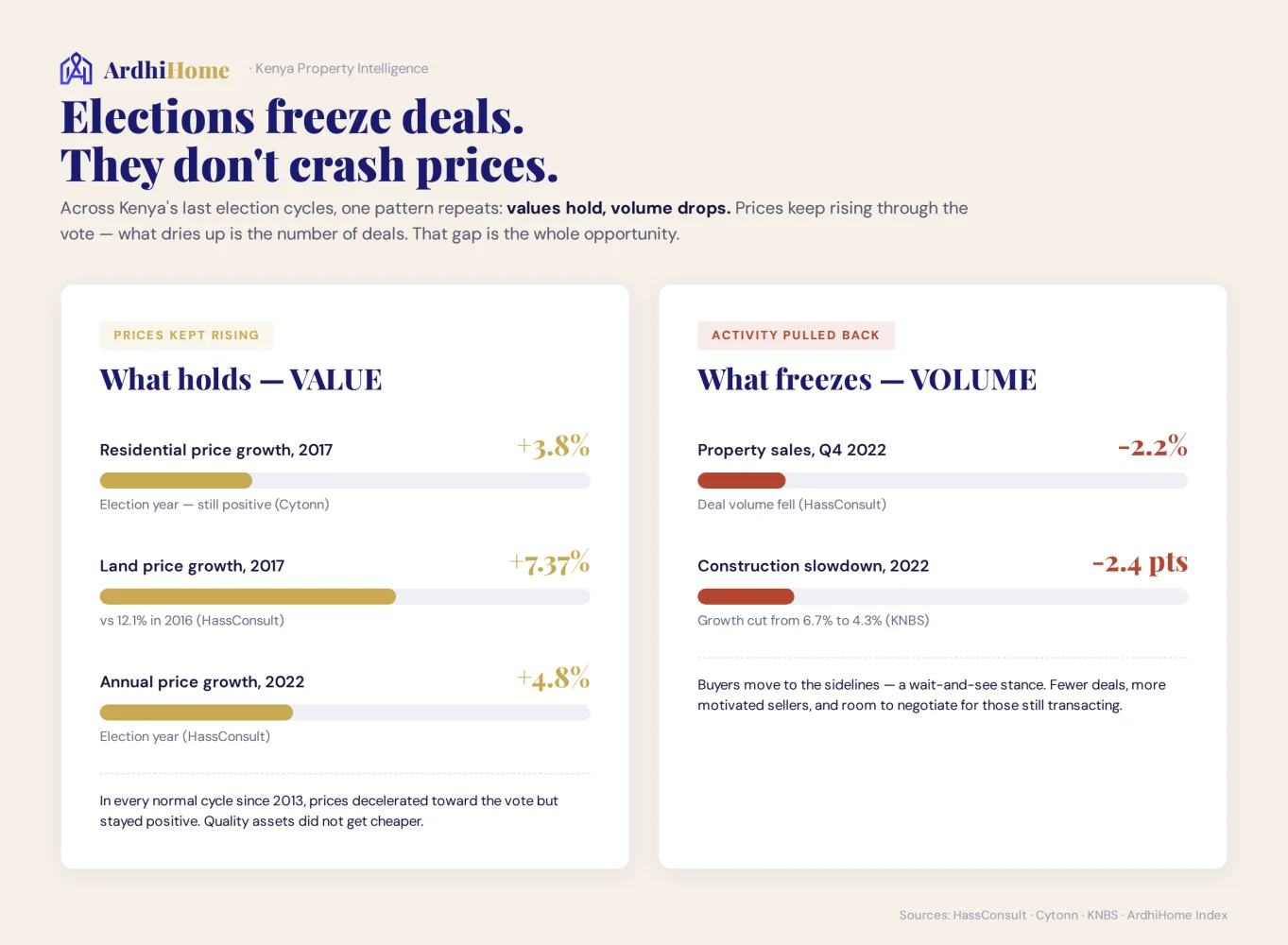
2017 — the textbook freeze. The 2017 cycle was drawn-out and tense: an August vote, a Supreme Court annulment, and an October re-run. Yet prices did not collapse. What collapsed was momentum. Cytonn's research recorded Nairobi residential price growth of roughly 3.8% that year — down from about 7.4% the year before, essentially halved. Overall returns eased to around 9.4% from 12.6%. On the land side, HassConsult clocked county land price growth of about 7.37% in 2017 against roughly 12.07% in 2016. Prices kept rising — just slowly. The market went quiet, not cheap.
2022 — the wait-and-see. The 2022 cycle followed the same shape. Activity was reasonably bullish early in the year, then buyers pulled back into a wait-and-see posture as August approached. HassConsult's data showed a 2.2% dip in property sales in the final quarter, with annual price growth of just 4.8%. Construction told the same story: KNBS recorded the sector growing 4.3% in Q3 2022, down from 6.7% a year earlier. Again — volumes and building activity softened; prices stayed largely intact. And by early the following year, activity was recovering.
The Gap
2007/08 — the exception that defines the risk. There is one cycle that did break value, and it is the reason the fear exists at all. The disputed December 2007 result triggered post-election violence that ran into February 2008, with more than 1,100 lives lost, over 350,000 people displaced, and — by CSIS's accounting — in excess of 117,000 private properties destroyed. That was not a market correction. It was a rupture. It is also the outlier: the one time in the modern record that political risk translated into physical destruction of assets rather than a temporary pause in dealmaking.
Two lessons sit inside that history. First, in a normal contested Kenyan election, the rational move is not to exit — it is to keep buying quality while transaction volume, and therefore competition, thins out. Second, the tail risk is real, and it is not distributed evenly. It concentrates in disputed, poorly documented and thinly held assets, and it spares assets underpinned by genuine, non-substitutable demand and clean title. Which is exactly what the resilience data shows: after even contentious elections, HassConsult found that areas backed by strong demand were not the ones that suffered.
That is the whole game. Real demand is resilient. Speculation corrects. An election just turns the volume up on that difference.
The freeze is already here
This is what makes July 2026 different from a normal "13 months out." You would expect the market to be calm this far from a vote. It isn't — it's already leaning defensive.
HassConsult's Q1 2026 indices show the classic pre-election signature arriving early. Land price growth in Nairobi's suburbs slowed to 0.8% in the quarter, down from 1.3% the previous quarter, settling at an average of KSh 228.8 million an acre. Satellite-town land grew just 0.5% — the slowest pace in five years. Most tellingly, HassConsult noted that investors are moving money into passive but liquid assets — unit trusts and government securities — in a clear wait-and-see stance. That is capital getting ready to sit out uncertainty, and it is happening a full year before it "should."
At the same time, the market is quietly splitting in two — and this is where the real opportunity lives.
The two-speed market
The headline "Kenyan property" no longer moves as one thing. Underneath the averages, two very different markets are running at different speeds, and the election will widen the gap between them.
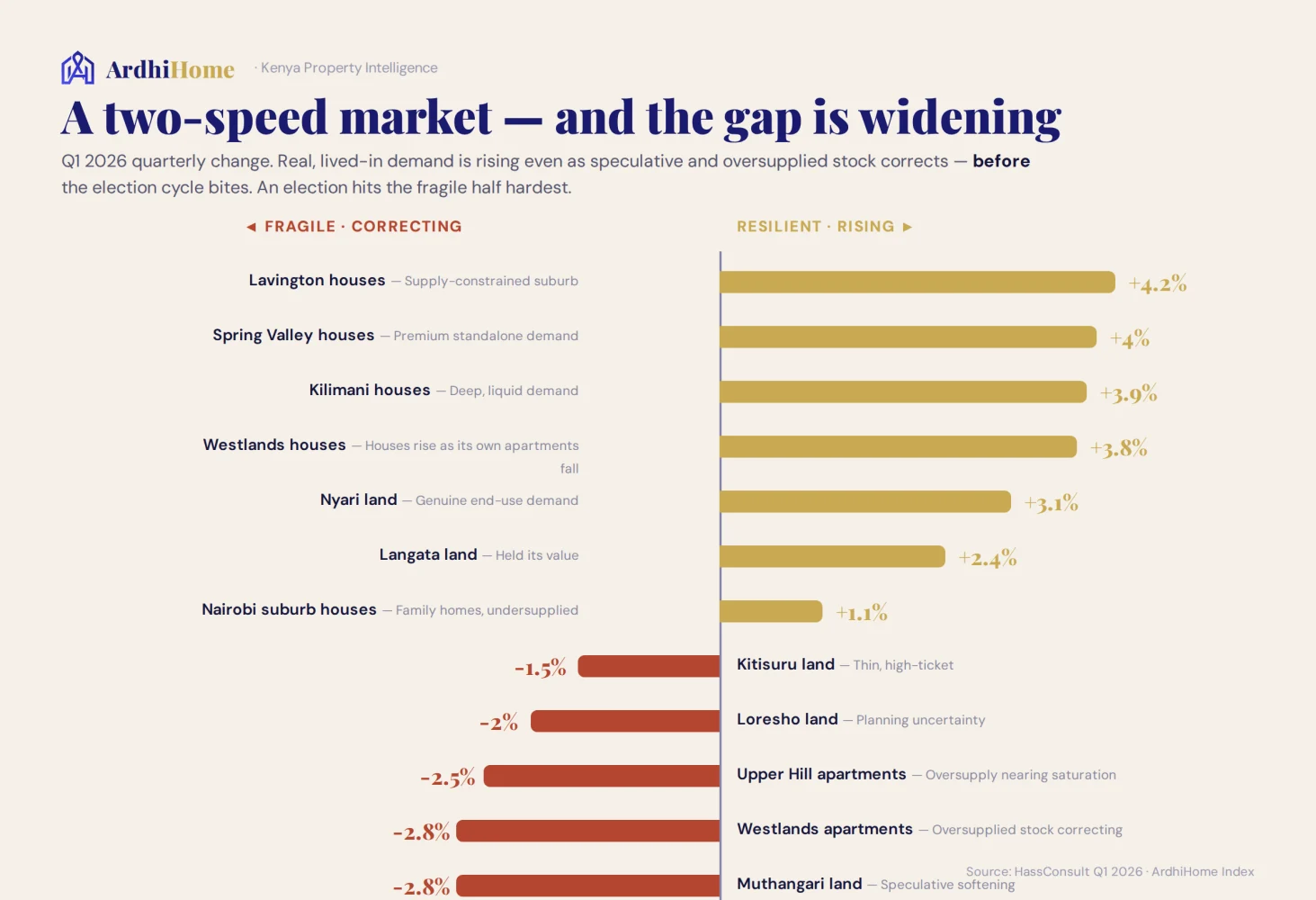
Speed one: real, lived-in demand — holding and rising. Standalone houses in Nairobi's suburbs rose 1.1% in Q1 2026, actually accelerating from 0.8% the prior quarter, on persistent undersupply of family homes. Rents hit historic highs: average suburban rent crossed the KSh 200,000 mark for the first time (KSh 201,832), and satellite-town rents reached a record KSh 64,765. HassConsult's rental yields held at 7.4% in the suburbs and ticked up to 5.3% in satellite towns. Within that, the strongest house-price growth clustered in genuinely desirable, supply-constrained pockets — Lavington (+4.2%), Spring Valley (+4.0%) and Kilimani (+3.9%). This is the resilient half: assets people actually live in, in places people actually want to be.
Speed two: speculative and oversupplied — already correcting. The other half is softening before the political cycle even bites. Apartments in oversupplied corridors are correcting: on the quarter, Westlands and Upper Hill apartment prices fell 2.8% and 2.5%, and over the year to March 2026 the correction ran deeper still — Westlands apartments down 7.9% and Upper Hill down 6.8%, with ten of the eighteen areas HassConsult tracks recording lower apartment prices as successive waves of construction hit saturation. On the land side, several premium suburbs went backwards in Q1 2026: Muthangari (-2.8%), Loresho (-2.0%) and Kitisuru (-1.5%). Nairobi County's planning-approval bottleneck — building approvals fell 9.3% in the twelve months to December 2025 — has stripped developers of visibility on what they can even build, freezing speculative land plays. This is the fragile half, and it is exactly the half that election-year risk hits hardest.
A Two Speed Market
Our own index sharpens the point. Across the 549 neighbourhood combinations ArdhiHome tracks, gross indicative yields swing from north of 20% in high-turnover, rental-dense corridors like Wood Avenue, Riverside, Kileleshwa and Syokimau down to the low single digits in trophy-but-illiquid addresses — Karen at roughly 3.0%, Muthaiga 2.3%, and the Nairobi and Mombasa CBDs at or below 2%. The neighbourhoods with deep, liquid demand — Kilimani (1,831 active sale listings), Westlands Area (1,710) and Kileleshwa (1,606) all cluster in the KSh 7–9 million band — are the ones that keep trading even when confidence thins. Illiquid, high-ticket assets are the ones that lock up.
The election playbook, then, is not "buy or don't buy." It is buy the resilient half, avoid the fragile half, and use the freeze in volume to your advantage.
The diaspora advantage nobody talks about
If you are a Kenyan buying from the US, the UK, Canada or the Gulf, this cycle hands you a structural edge — provided you understand it.
Start with the money. Diaspora remittances remain Kenya's single largest source of foreign exchange, ahead of tourism and traditional exports. In the twelve months to June 2026, formal inflows were about USD 4.96 billion, and a KNBS household survey suggests the true figure, including informal channels, is roughly 43% larger than the formal number captures. The flows have softened recently — down 2.4% year-on-year, with the CBK trimming its 2026 forecast to around USD 5.1 billion on Gulf-corridor pressure — but the shilling has held near KSh 129 to the dollar, and dollar-denominated savings buy more shilling-priced property than they did a few years ago.
Now layer the election on top. A local buyer feels the freeze directly — their income, their credit, their confidence all move with the domestic mood. A diaspora buyer with dollars, a five-to-ten-year horizon and no need to transact on the local calendar is largely insulated from the very liquidity freeze that pushes local competition to the sidelines. That is the edge: you can transact when the local market can't, into a market where prices are holding and competition is thin.
But that edge comes with a warning stamped on it by 2007/08. A thin, anxious, pre-election market is precisely when fraud rises — because desperation rises, scrutiny drops, and buyers who are 12,000 kilometres away can't walk the plot. The diaspora advantage only works if it is paired with verification. Buying blind into an election window is how the advantage becomes the trap.
The playbook: how to position in the next 13 months
If you are buying (and you can), buy now — deliberately. The window from now through roughly Q1 2027 is the calm before the tightening. Transaction volume is thinning, which means less competition, more motivated sellers, and more room to negotiate on quality assets that are holding their value. Concentrate on the resilient half: family houses in supply-constrained suburbs, and well-located, well-titled homes in genuine-demand satellite corridors (Ruiru, Juja, Syokimau, Kitengela, Rongai). Prioritise clean, verified title above everything — in an election window, documentation is not paperwork, it is protection.
If you are selling, move before the freeze deepens. Values are holding today, but liquidity is not guaranteed as 2027 approaches and buyers retreat to the sidelines. If you need to transact, the coming months offer better depth of buyers than the campaign period will. Price realistically against genuine demand, present the asset properly, and get verified — a verified, well-presented listing is what keeps selling when unverified stock stops moving.
If you are diaspora, use your structural edge — with guardrails. Your dollars, your horizon and your independence from the local calendar let you buy while locals wait. Do it. But never send money against a property you or a trusted, accountable representative has not verified end to end — title, ownership, encumbrances, the developer's track record. Route funds through proper legal and escrow structures, never directly to a seller on trust. The freeze is your opportunity; verification is what stops it becoming someone else's.
If you are a developer, sell through the calm and protect your pipeline. The pre-election window is your best remaining runway of confident buyers before the campaign slows uptake. Bring credible, well-documented inventory to a diaspora audience that can still transact, lean on completion guarantees and transparent milestones, and don't count on speculative appetite that the political cycle is already draining.
The bottom line
Kenya's property market has 13 months of relative normal before a contested election tightens everything. History is clear about what that tightening looks like: not a crash in what quality assets are worth, but a freeze in how much trades — and a widening gap between the resilient half of the market and the speculative half.
The people who lose in election cycles are the ones who sit out waiting for a discount that never arrives, and the ones who transact blind into a thinning market where fraud is quietly rising. The people who win are the ones who buy real demand, insist on verified title, and move while everyone else waits.
That is the entire ArdhiHome thesis in one sentence, and an election is simply the moment it matters most: in a market where trust is scarce, verification is the edge.

The ArdhiHome Kenya Property Intelligence Report is published monthly. ArdhiHome verifies agents, enforces listing standards, and gives buyers — at home and in the diaspora — the trust infrastructure to transact with confidence.
#TrustIsInfrastructure · Buy. Sell. Build. With Confidence.