Every Kenyan abroad has a Karen dream.
Big plot. Mature trees. The quiet you can't find anywhere else in Nairobi. Children running in a compound. A place to come home to.
I understand it completely. I'm Kenyan diaspora too.
But here's what the data says — and what almost nobody in the real estate industry will tell you directly.
The numbers on Karen
Median sale price: KSh 120,000,000 Median monthly rent: KSh 300,000 Gross rental yield: 3.0%
That's not a typo.
On a KSh 120 million property, you earn KSh 3.6 million a year in rent. Before management fees. Before maintenance. Before the months your property sits vacant because the Karen rental market has 449 active rental listings but only 184 for-sale listings — meaning the rental supply significantly outpaces buyer demand.
Kenya's 91-day T-bill rate has historically hovered around 10–16%. You are earning 3% on a KSh 120 million real estate asset.
This is not me saying don't buy in Karen. It's me saying: know why you're buying.
If you're buying Karen for capital appreciation — betting that Nairobi land values keep rising — that's a rational thesis with historical evidence behind it.
If you're buying Karen because you want to come home to somewhere beautiful and meaningful — that's a legitimate personal decision that no spreadsheet should override.
But if you're buying Karen because you expect it to generate strong passive rental income from abroad, the data says you will be disappointed.
What the data actually shows for income-focused diaspora investors
We spent the last three months building Kenya's most detailed publicly available neighbourhood intelligence database — sourcing from BuyRentKenya and Property24, cross-referencing 1,800+ listings across Nairobi Metro and the Coast, and calculating real gross rental yields for every major neighbourhood.
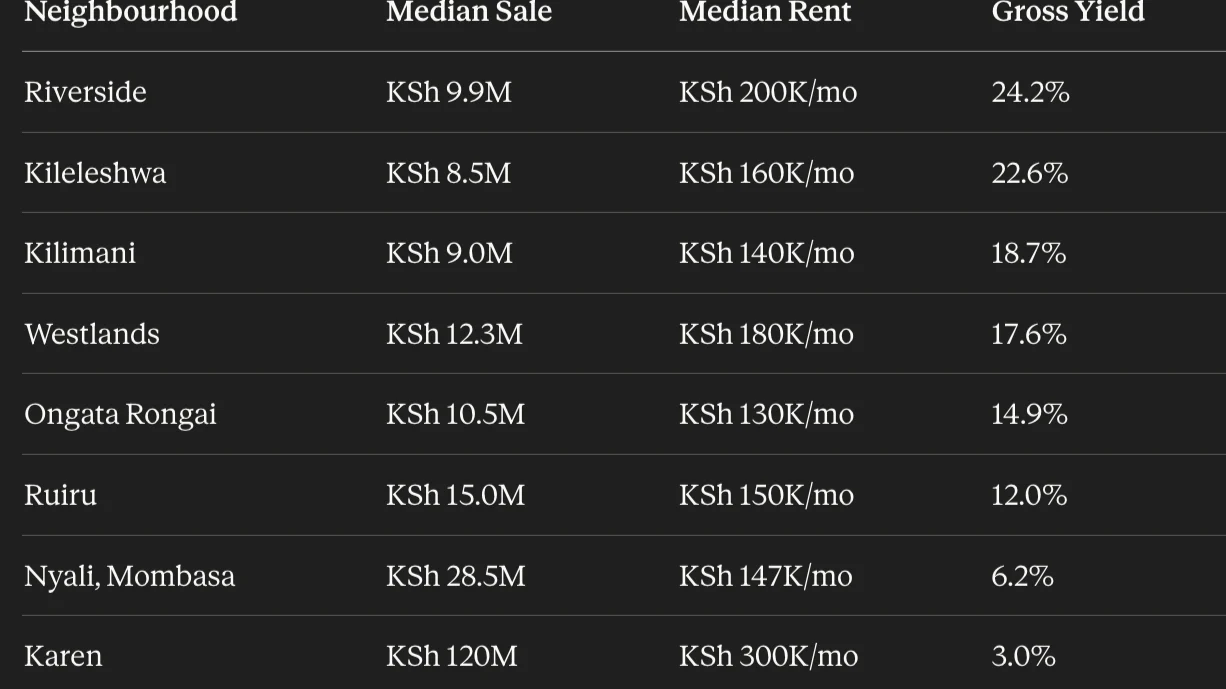
Here's what we found for the neighbourhoods diaspora buyers ask about most:
NeighbourhoodMedian SaleMedian RentGross YieldRiversideKSh 9.9MKSh 200K/mo24.2%KileleshwaKSh 8.5MKSh 160K/mo22.6%KilimaniKSh 9.0MKSh 140K/mo18.7%WestlandsKSh 12.3MKSh 180K/mo17.6%Ongata RongaiKSh 10.5MKSh 130K/mo14.9%RuiruKSh 15.0MKSh 150K/mo12.0%Nyali, MombasaKSh 28.5MKSh 147K/mo6.2%KarenKSh 120MKSh 300K/mo3.0%
Kileleshwa — a neighbourhood that receives almost no developer marketing attention — is delivering 22.6% gross yield at a lower entry price than Kilimani, with lower fraud risk than either of its more famous neighbours. 1,606 active for-sale listings. 281 active rental listings. Deep, liquid market.
Nobody talks about Kileleshwa because there are no off-plan apartments to sell you there.
The thing nobody says about Ruiru
Ruiru is the most heavily marketed neighbourhood to Kenyans abroad. Facebook groups. WhatsApp broadcasts. "Affordable gated community" off-plan schemes that show up in every diaspora timeline.
The data: KSh 15,000,000 median sale price — the highest of any satellite town we tracked. 12.0% gross yield.
The same KSh 15M invested in a Kileleshwa apartment delivers 22.6% yield in an established Nairobi neighbourhood with professional management infrastructure and a deeper rental market.
The Ruiru premium is not a location premium. It's a marketing premium. It's the cost of being the most advertised corridor to Kenyans abroad.
This is not to say Ruiru is a bad investment. The Thika corridor has real long-term infrastructure tailwinds — the Superhighway, industrial growth, population expansion. The capital appreciation argument is credible.
But income investors should run the comparative numbers before committing.
Why we published this
Kenya's property market has a trust problem that is structural, not incidental.
Over 10,000 land fraud cases are filed in Kenya annually. Unlicensed agents operate in the open. Off-plan schemes target diaspora buyers with "exclusive pre-launch pricing" for projects that are never built. Title deed complexity catches buyers who didn't know what questions to ask.
The people hurt most are diaspora buyers — managing transactions from thousands of miles away, relying on information from people with financial incentives to tell them what they want to hear.
ArdhiHome exists to fix this. Our platform verifies every agent against EARB registration. Our listings are cross-checked. Our job is to be the layer of independent verification between a serious buyer and a transaction that could go very wrong.
The Truth Reports are a part of that. We published ten of them this week — Kilimani, Kileleshwa, Westlands, Riverside, Karen, Lavington, Ongata Rongai, Syokimau, Ruiru, and Nyali/Mombasa. All free. All data-sourced. Each one includes the fraud risk breakdown by category that no listing platform publishes.
You can find all ten at ardhihome.com.
The question I want to leave you with
Before you make any Kenya property decision from abroad, ask yourself:
Is the information I'm acting on coming from someone who makes money when I buy — or from someone whose job is to tell me the truth regardless of whether I buy?
The Kenya real estate market needs more of the latter. We're trying to be that.
If these numbers were useful to you, share this with one person in your network who's thinking about buying back home. That's all I ask.
And if you want to discuss what the data means for your specific situation — I'm reachable. That's what we're here for.
Kuya Machanja is the Founder & Managing Director of ArdhiHome ( ardhihome.com), Kenya's trusted real estate platform. Buy. Sell. Build. With Confidence.